Burglary of Edward Niedland’s home
The Mystery of The Invisible DogThe Burglary of Edward Niedland’s home is the theft of the Carpathian Hound from Fenton Prentice’s residence, where the sculpture had been left by Charles Niedland after Edward’s gallery show. The break-in becomes more than a straightforward theft when its perpetrator turns the surrounding neighborhood into a series of hiding places: a courtyard escape, a church disguise, and a sculpture left concealed in plain sight. The Three Investigators’ later reconstruction connects these moves into a single, improvised flight from the police.
Background and Opportunity
Edward Niedland had kept a small collection of his own work and pieces by other artists at his house. After Edward died, Charles moved the works to a safer place. When Edward’s gallery show ended, Charles began returning borrowed pieces to their patrons. The Carpathian Hound happened to be at Fenton Prentice’s residence during this process; its presence there was chance, not the result of a planned delivery to the burglar.
Charles explained that he had brought the sculpture to Fenton late the previous afternoon, intending to deliver it and spend time sorting Edward’s books. Fenton was expecting the boys, so Charles left the Hound at the residence and went out to eat before returning. On his return, he saw an intruder through a window and called the police from a neighbor’s phone. That sequence helps explain both why the sculpture was available to steal and why Charles was nearby when the crime was discovered.
The first account offered to the boys treated the break-in as ordinary: the burglar had used a glass cutter to make a hole in a kitchen windowpane, reached through, and released the latch. But the apparent simplicity of the entry did not explain why the intruder took only the Carpathian Hound. Fenton, who sat tired but calm after the theft, emphasized that single missing object. His insistence kept the investigation focused on the sculpture rather than on the mechanics of the window.
Break-in and Escape
During the escape, a sound from outside might have been a backfire or a gunshot. Pete Crenshaw rushed to the balcony railing, but the courtyard below was empty. Shouting came from behind the building; a gate slammed, and footsteps pounded on a staircase out of sight. A man in a dark windbreaker and black ski hood then ran through a passage into the courtyard, past the pool, and out the front gate to the street. Pete dashed downstairs, where a policeman appeared at the rear of the courtyard and ordered the runner to stop.
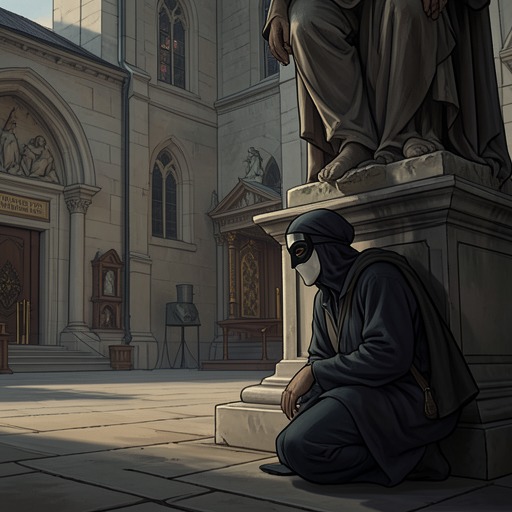
Jupiter Jones later reconstructed the burglar’s immediate problem: the neighborhood was full of police searching for a man who had broken into a house on the next street. The church offered cover when it seemed likely to be searched. The fugitive put on a cape and mitre and posed as a statue. The disguise placed him almost within reach of the officers who searched the church, yet let him pass as part of its furnishings while they looked for a burglar.
The concealment was precarious. When the caretaker came down from the choir loft, the disguised man was startled. The caretaker later returned to the church, where he might have noticed a statue that did not belong there. He had a bad concussion and was being treated for shock; he believed he had stumbled. Jupiter suggested that the burglar may have struck him after the caretaker turned out some of the lights, but the account presents the blow as a reconstruction, not as something the injured caretaker could remember.
The Hound Hidden and Found
Pete Crenshaw’s later account fills out the escape route. With police close to catching him, the burglar could not safely go home. He ran into St Jude’s Church, posed as a statue, struck Earl with his gun, and hid the Carpathian Hound. He then slipped outside, discarded the ski mask and dark jacket in a rubbish bin near the park, and walked home. The dropped disguise marks a change from urgent flight to an attempt to appear unremarkable; the stolen sculpture, meanwhile, remained behind.
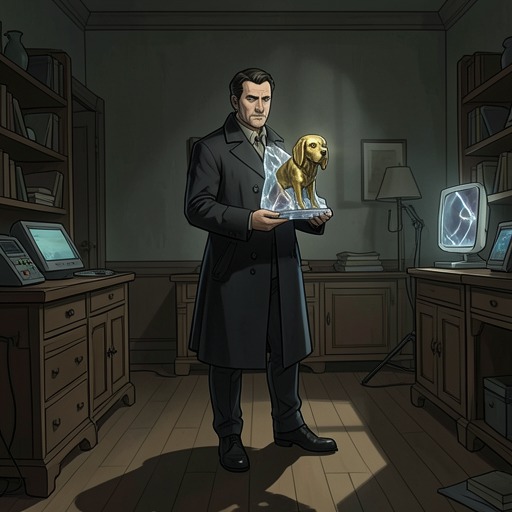
The sculpture was eventually recovered from a swimming pool. Jupiter Jones surfaced with it in his hand and offered it to Fenton Prentice, who turned it over and examined it. The figure was about six inches tall, a heavily muscled dog with a massive square head, gold-rimmed eyes, and gold froth on its crystal jaws; a human skull lay between its feet. A long gilt cord had been tied around its middle. Jupiter explained that the burglar had lowered the sculpture by this cord until it touched the pool bottom, then let go. Against the pool’s random pattern of blue and gold tiles, the gold cord was difficult to see. The concealment required no entry into the water by the burglar.
This discovery makes the object’s physical details part of the solution. The cord was not merely something attached to the sculpture: it allowed the burglar to place the Hound at the bottom of the pool while leaving it visually lost among the tiles. Its return to the surface, in Jupiter’s hand, reverses that concealment and confirms that the apparent absence of the stolen object had been engineered.
Reconstruction and Significance
The burglary’s course emerges through successive explanations rather than from a single uninterrupted view. Charles supplies the chance circumstances that left the Hound at Fenton’s residence and the moment he noticed the intruder. Jupiter explains how the fugitive used the church as a disguise, while Pete recounts the hurried decisions that followed: striking Earl, hiding the sculpture, discarding the clothes, and walking home. The recovered Hound then provides physical confirmation of a separate hiding method in the pool.
The Three Investigators’ account also distinguishes the known escape from a tempting but mistaken continuation. The film director suggests that the burglar returned the next night for the Hound disguised as the phantom priest. Jupiter rejects this: John Murphy had told them that he, too, saw the phantom priest. The supposed return therefore cannot simply be treated as the burglar’s disguise or as an established part of the theft. That correction preserves the event’s central pattern without forcing every strange occurrence into one explanation: the burglar repeatedly exploited ordinary spaces and disguises, but the later appearance of the phantom priest was not, on the evidence given, his doing.
What begins as a glass-cutter entry ends as a chain of improvised concealments. The residence’s window provides access; the courtyard and church buy escape; the pool hides the stolen sculpture. Each location changes the problem facing the burglar, and each leaves a clue that the investigators can connect afterward. The Hound’s recovery turns a seemingly empty pool into evidence of the whole method: a conspicuous crystal dog made invisible by placement, pattern, and the expectation that it would not be there.